Advertisement
Red Bull Racing is a team transformed to the point where next season should be considered as the start of its second era in Formula 1. The question is whether this has been reimagined and enhanced to rise to the challenges of the next 20 years, or if the magic that made it so successful has been lost?
When Red Bull co-founder Dietrich Mateschitz lost his battle with cancer in October 2022, the company’s F1 operations could never be the same again – at least, not in the medium-to-long term. What was less clear is exactly what form this shift might take, but few would have imagined it would be so extreme that, heading into 2026, all of the key leadership figures that made the team great would be gone.
Mateschitz’s unique position meant his absence couldn’t fail to precipitate change. He owned 49% of Red Bull as a whole, with the family of fellow founder Chaleo Yoovidhya holding the other 51%, but had management control of almost all of its activities. An autocratic leader, his vision and enthusiasm drove its motorsport involvement and helped to build Red Bull into a company that was turning over in excess of $10billion when he passed away. And it has continued to grow since.
He was profoundly influential in F1 through his ownership of two teams – 20% of the grid – after having been asked to save ailing Minardi when Paul Stoddart could no longer keep it going and unexpectedly adding a second team to his stable in September 2006. Yet the power he wielded belied the low profile he kept. Mateschitz eschewed the day-to-day politicking in the paddock and was in no sense an autocrat in the interventionalist sense. For some, such influence is a status symbol to be flaunted; for Mateschitz, it was a tool to be used only when necessary. For the rest, he had his ‘vicars on earth’ to do the job.
He only occasionally made public pronouncements, but when he did they carried weight. A quit threat from Red Bull meant something, and was not overused, giving him political power that was cleverly wielded and helped his team to transform grand prix racing. Don’t underestimate how profound Red Bull’s effect was on the direction of F1, particularly when it came to testing the limits of – and ultimately breaking – the well-intentioned but fragile cost-control attempts of the resource restriction agreement and its successors.
After 2022, that dynamic became impossible. No longer was it Mateschitz’s pet project, it was now clearly a part of a more conventional global corporation. Writers of fiction and histories throughout the ages are all too familiar with what the loss of such a power center can mean for an ecosystem of this type, which once benefited from such leadership and stability.
So how did we get from that to Red Bull Racing, the fourth most successful team in grand prix history with 130 wins, being irrevocably changed with team principal Christian Horner, motorsport advisor Helmut Marko, technical supremo Adrian Newey and sporting director Jonathan Wheatley all gone? And just how different is the ‘new’ Red Bull?
Advertisement
Fundamentally, it is more corporate. While Mateschitz’s son, Mark, inherited his stake and remains heavily involved, the team now falls under the oversight of Oliver Mintzlaff, Red Bull’s CEO of Corporate Projects and New Investments. He was conspicuous at a number of grands prix this year after Horner’s departure in July, but also has oversight of Red Bull’s many other sporting properties, including the soccer teams RB Leipzig in Germany, RB Salzburg in Austria and the New York Red Bulls. There’s also a larger committee that is part of that management process.
Mintzlaff is a key player in the changes made. He recently spoke of “distractions”, or rather the desire to remove them, being a motivating factor. “It was an open secret that too many things were going on in and around the team,” said Mintzalff earlier this month. He characterized the revival of form and Max Verstappen coming within two points of winning the drivers’ championship as symptomatic of the renewed focus that came from the changes. Horner, and the baggage he carried, was clearly considered a big part of this. However, Horner also had more power and control over Red Bull’s F1 empire than could ever sit well with the wider Red Bull company, so it would be naive to imagine that curbing this wasn’t part of the equation.
Advertisement
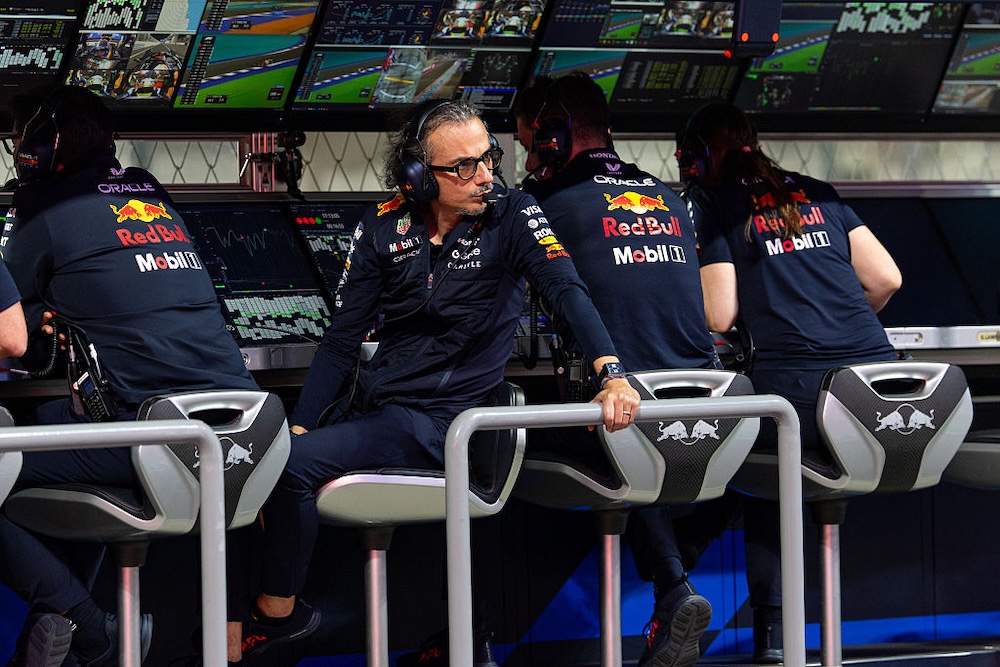
Laurent Mekies, appointed as CEO and team principal in Horner’s place, holds the same job title but not the same power. How could he, given Horner built up the team and therefore weaved himself into every aspect of its activities? Mekies is a razor-sharp engineer, intelligent, with plenty of management experience from Racing Bulls and Ferrari, where he was deputy team principal, before that. However, he is more focused on the engineering side, and while his role stretches beyond that, compared to Horner he’s far more a functionary. This isn’t meant as an insult to his abilities, merely that the corporate shackles that Horner shook off, if he ever had them to start with, are firmly clamped to him. It was Horner’s company, but Mekies is a company man and his power is contained.