How JR Hildebrand pivoted from IndyCar to Pikes Peak…and to NASCAR once he got there

Advertisement

The Pikes Peak International Hill Climb has welcomed thousands of the world’s most talented racers over its 103-year history, many who made their name in other racing series prior to taking on the mountain. One thing is for certain among them: none are content to settle for the expected, and all are looking to push themselves to the limit.

Few modern racers embody that spirit more than JR Hildebrand. While he’s best known for his IndyCar career, his name has appeared frequently on the Pikes Peak entry list, often with the intent of adapting something from another form of racing to tackle the mountain. Although his 2025 entry wasn’t the one he initially planned on, it became one of the signature machines of this year’s event.

Hildebrand’s debut on the mountain came in 2018, when he finished second in the inaugural Porsche Pikes Peak Trophy by Yokohama division. He admits that he fell in love with it right away, not only for the “audacity of the challenge” but also for the sheer diversity of machines on the entry list – a stark contrast not only to the spec chassis of IndyCar, but also to the Cayman GT4 Clubsport models in his debut.

“Getting there, spending race week with all the other competitors, seeing what everybody else is doing, really seeing the variety of what’s up on the mountain every year – but doing so by being among that community – it really punches you in the face,” he says. “(You) see how wide that void is, the number of different ways that people are showing up with their teams and crews and cars, from multi-million-dollar factory prototypes like Volkswagen and Ford to homegrown builds and programs run out of people’s garages.

“I’m coming from the world of mainstream motorsport, where everything has just become increasingly more strict and constrained in terms of what you’re allowed to do. I think the fact that Pikes Peak stands in stark contrast to that is what really made it feel like it mattered to me, when I did it the first time around in 2018.”

Bitten by the bug, Hildebrand made two attempts to adapt a Dallara IR-18 to go from IndyCar to Pikes Peak, but neither came to fruition. That taught him an important lesson: have a plan B.

“In the background, I’ve been making sure that should these kinds of situations arise, or should I just get to a point where I don’t have anything, major or not, to be sure that I can come do it on my own accord,” he says. “That’s really where this program ended up this year.”
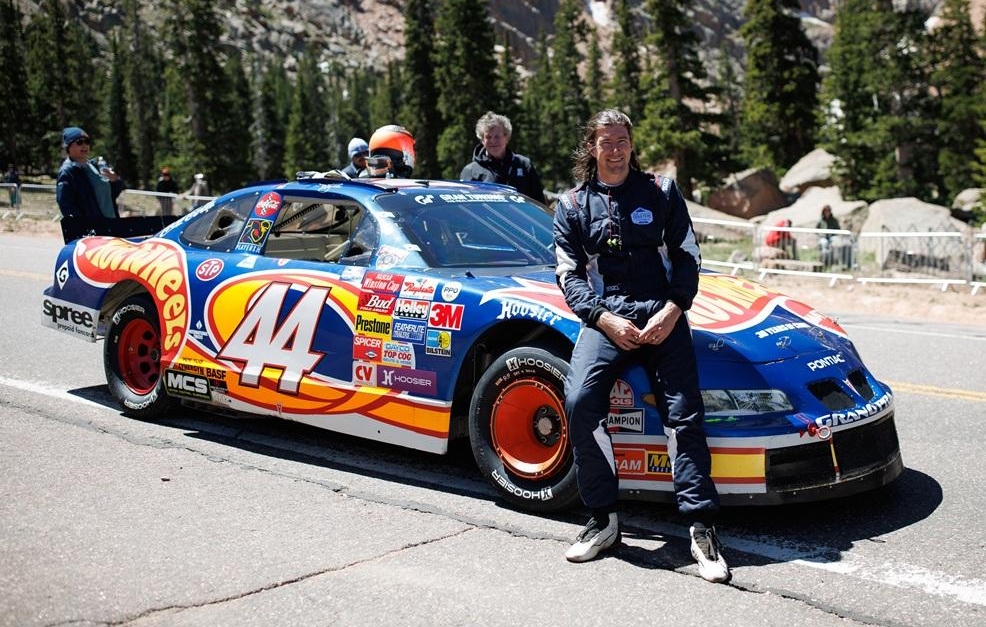
“The thing that’s been interesting is how many race fans and people from NASCAR heard about this. I think a lot of it is on the grounds that this car is so beloved,” Hildebrand says.

Enter Kyle Petty’s NASCAR Cup Series Pontiac Grand Prix, still carrying the Hot Wheels colors that dominated so many toy aisles in the ’90s. Hildebrand was origin ally slated to compete in a 2025 Chevrolet Corvette in the Time Attack 1 division, but had to pivot after that program came apart late in the spring. So, he switched gears to prep one of America’s most famous stock cars for a run up the mountain, prepping it in a single-car garage and even making a motor swap after heading to Colorado.
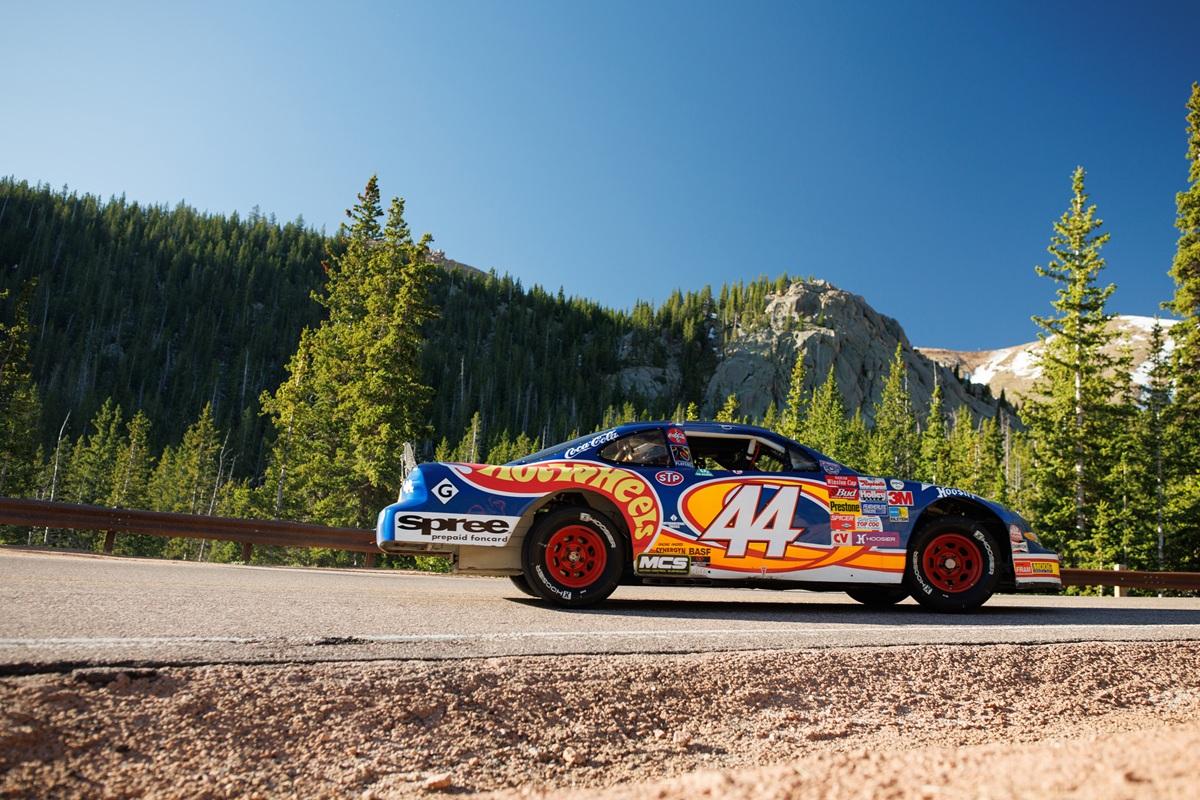
The team got the car to Colorado Springs before the second test weekend, discovered an issue while testing at Pueblo Motorsports Park, and spent the week before race week getting a new engine shipped and swapped in.

Advertisement

“We hadn’t even got the car up on the mountain yet, and it already generated quite a bit of hype,” he says. “I have a lot of crazy ideas in my head, and I know that not all of them register to everybody all the time. The things that I think are cool, I’m fully willing to accept that not all of them are cool in a mainstream sense.

“But the thing that’s been interesting is how many race fans and people from NASCAR heard about this. I think a lot of it is on the grounds that this car is so beloved. Going every year [to Sonoma] to watch this car race, next to the [No.] 3, this was the car that I was cheering for the most. I definitely have a personal connection to it.”

“On Instagram, a number of the followers I picked up from posting about it, I think are really just diehard NASCAR fans that remember the car in that time period in the sport who were excited to see the car back in action. I think it speaks to the power of the openness that Pikes Peak allows for. It’s really special in terms of the ability to do unusual things.”

Of course, the last-minute switch meant a highly compressed timeline, and that meant keeping things close to original spec. While Hildebrand admits that he could have developed all sorts of areas on the car with six months of prep time, the No. 44 showed up with Jeff Gordon’s race-winning Sonoma setup in 1998, courtesy of Ray Evernham, as its baseline.

Advertisement

“Frankly, racing the car at Pikes Peak has always been on the back of my mind. It’s been something that I’ve talked about since I got the car two years ago,” Hildebrand says. “But it certainly wasn’t the plan for this year up until like May. You’re in a hole now, you have a whole other level of needing for things not to go wrong.

Hildebrand’s Pontiac added to the eclectic mix in the Pikes Peak Open class this year.

The 156 turns of Pikes Peak may not be quite like the orange track of a Hot Wheels set, but putting a classic NASCAR ride above the clouds made for some of the most popular pictures of race week. While he admitted that he had no idea where he’d stack up in Pikes Peak Open going into the race, Hildebrand’s program only picked up more momentum as race week went on, and not just because fans were flocking to the familiar machine.

In fact, it was only event rules that kept him out of this year’s Fast 15. As the last car off the line in Thursday qualifying, he posted a 4m08.429s on his third run, but because not everyone looking to make a pass got to run, it didn’t count. Still, Hildebrand was thrilled to have the car in great working order in time for Sunday’s race.

“I was just so glad to finally get the car running right, just in time for qualifying,” he said. “We were still figuring a few things out, but it felt more like we’re in fine-tuning mode. We had done a rear gearing change overnight, so the first run was a little easy just to break that in. The second run was still on old tires, but I had the gearing strategy dialed in my head, and we threw stickers on it and picked off another four or five seconds on the last run.”

Advertisement

On the shortened course on race day, Hildebrand and his team scored the fourth-fastest time in Pikes Peak Open. PPIHC veterans Jimmy Ford and Loni Unser, and winner Romain Dumas in the Ford Super Mustang Mach E, placed ahead of him. It was a diverse group of machines that echoed Hildebrand’s love for the wide-open takes on motorsport that Pikes Peak rewards each year.

“That’s kind of the beauty of it, the fact that with my 1999 Hot Wheels NASCAR car, I’m in the same group as Romain Dumas in the full prototype Mach E,” Hildebrand says. “It’s really what makes the whole thing cool. I think that that’s a perfect reflection of not only how Pikes Peak is different than most other racing these days, but also where there is room to take advantage of kind of writing your own script.

“I’ve been around motorsport, and I’ve been really fortunate to be a hired gun, for a long time, but you kind of get into having to make sense of the commercial side of it. I think going forward it’s going to be all about writing your own script, telling a different and compelling story. As far as I’m concerned, this is just kind of the tip of the iceberg.”