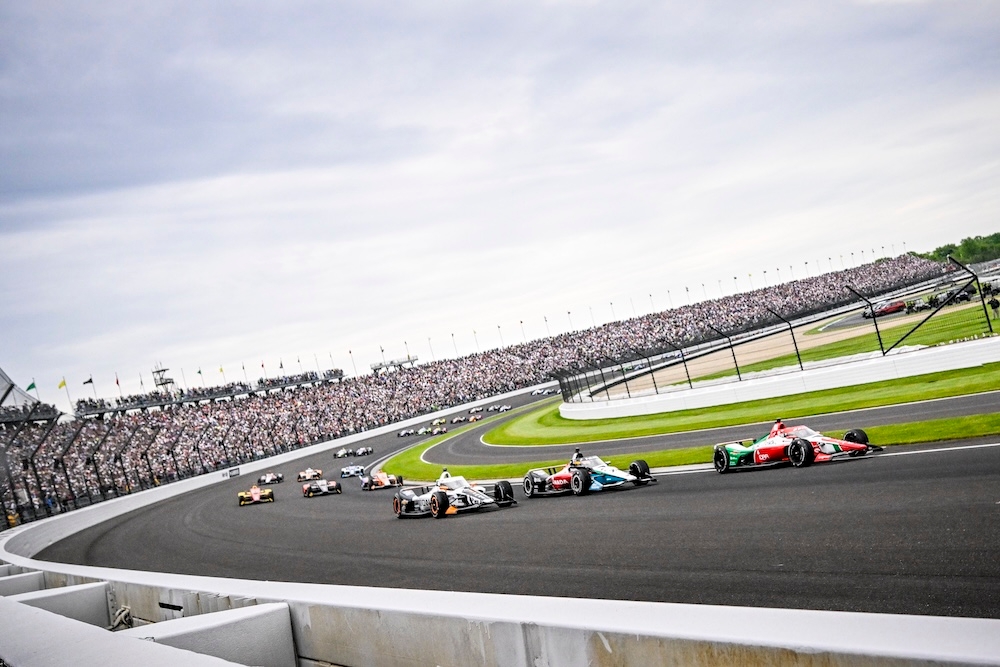
. Look out for additional installments in the coming days.
The decision by IndyCar to delay its next chassis and engine formula to 2028 has left the series with a different issue to address.
Chevrolet and Honda have provided the current 2.2-liter turbocharged V6 engines since 2012, signed multiple supply extensions along the way, and will see their latest contracts come to an end after the 2026 championship is finished.
Under the previous new-car introduction plan, Dallara would deliver the vehicles for the 2027 season and IndyCar’s revised engine formula would power those models as part of a seamless transition from old cars to new. However, with the need to push the new car to 2028, the series is facing the possibility of a gap year in 2027 where no commitments from Chevy or Honda to power the field have been received.
The series is actively working to get both brands to stay and supply the new 2.4-liter twin-turbo V6s starting in 2028 while committing to one more year of service with the 2.2s for 2027, but IndyCar continues to wait on both brands to signal their intent for the future.
The best outcome would be to have Chevy and Honda agree to stay for the rest of the decade, continue to invest more than eight figures per year with their respective engine programs as marketing and promotional expenditures, cover the gap year, and step directly into the new formula with bigger and more powerful internal combustion engines and stronger energy recovery systems.
But with no guarantees the adversaries will add more rounds to their IndyCar fight, the series has prepared itself for all outcomes.
“We hope that’s not the case, but you absolutely have to plan for everything,” Mark Sibla, IndyCar’s Sr. VP of competition and operations, told RACER. “I can certainly tell you that we’ve done that work, and that’s in place.”
Anything other than holding onto both would involve significant changes to the series; the possible permutations are many, starting with Chevy or Honda being the lone manufacturer to commit. Doing so would entail supporting the entire field of 25-27 full-time cars and 33-plus entries at the Indianapolis 500. From a historical perspective, Honda was the last IndyCar manufacturer to agree to single-supplier status from 2006-2011 after Chevy and Toyota withdrew following the 2005 season.
The IndyCar engine lease program in 2025 came at a cost cap of $1.45 million per car and included four engines that were meant to last the entire season. Chevy and Honda are known to subsidize each lease in order to bring the price down to the $1.45 million limit, and if one brand were to leave, the willingness for the other to continue losing money on each lease could change and lead to a change in pricing.
IndyCar is planning for multiple engine supply scenarios in 2027 if either – or both – of its current engine suppliers decides to exit after 2026. Doug Matthews/Penske Entertainment
If both depart and end their vast annual financial outlays to participate in the series, IndyCar will need to explore a Plan B which would likely start with trying to strike a deal with Ilmor Engineering, the company behind Team Chevy’s IndyCar program, or Honda Racing Corporation US, which handles all aspects Honda’s IndyCar effort, in a supplier-for-hire arrangement.
Advertisement
Of the two options, Ilmor would be the easiest solution to pursue as Roger Penske, who co-owns IndyCar, is the co-founder and co-owner of Ilmor. Nonetheless, with limited time to seek the building of a new 2.2 to slot into the existing car by 2027, entering into an agreement with an Ilmor or HRC to deploy one of their large pool of engines is the fastest pathway to a solution.
And could hiring an Ilmor or HRC to supply engines and seeking a new manufacturer to pay for badging those engines be another way forward? What about one manufacturer badging half of the motors and a second brand taking the other half? The options aren’t endless, but IndyCar has numerous avenues to pursue if necessary.
“It’s a lot of good questions,” Sibla said. “We’ve looked at not only, let’s call that a Plan B, but even variations on a Plan B. So if we go to this plan, how does it still open us up to opportunities with other auto manufacturers? Or do we go in a different direction? And what does that look like?”
The clock is ticking for interested manufacturers to produce engines conforming to the 2028 formula and be ready to start testing when Dallara delivers prototype cars to each brand next summer. Until a Chevy, Honda, or other auto companies execute supply contracts with IndyCar, the specter of the gap year and whatever might happen afterwards will await resolution.
“The formula we’ll build, after taking in all these inputs, is a formula that’s attractive to our two OEMS, and attractive to somebody else too,” Sibla said.
“So that either leads to a situation of, maybe we’ve got more than just two, or maybe we have two, but it’s not the current two. There’s multiple levels to the plans.”
We use cookies to ensure that we give you the best experience on our website. If you continue to use this site we will assume that you are happy with it.