Advertisement
RACER’S Marshall Pruett has spent the last year tracking developments with the IndyCar Series’ new chassis, engine, and the rest of what’s on the way for 2028, which we’re presenting in a multi-part feature. So far we’ve laid out the timeline for the rollout and explained what to expect from the new chassis and how the series arrived at the new engine formula. Look out for additional installments in the coming days.
The new internal combustion engine formula coming to IndyCar will create motors that are slightly bigger and more powerful than the units found in today’s cars. But not by a significant amount.
In fact, the new 2.4-liter twin-turbo V6 template for 2028 should be familiar to those who’ve followed the series in recent years. The motors are founded upon technology that’s in play today, as the upcoming engines won’t venture far outside of what IndyCar has used since 2012 with its 2.2-liter turbo V6s. And that’s by design.
In common with the 2.2, the 2.4 will make use of high-pressure direct fuel-injection, spin to upwards of 12,000rpm, rely on forced induction from two new, bigger, and mandatory turbochargers managed by electronic wastegates, and so on. With only minor variations, the blueprint for the 2.4 is the 2.2 it will replace. Horsepower will rise, and so will the contribution from the energy recovery system, which we’ll cover in a separate story.
If output targets of 800hp with the pistons and 100 hp with the batteries are hit, the 2028 powertrain will combine to put 900hp to the ground, an improvement of approximately 100hp over 2025’s hybrid package, with headroom for that overall number to grow towards 950hp or more as IndyCar ventures into the 2030s.
The increase in power from the 2.2 isn’t meant to be strictly a function of the rise with cubic capacity to 2.4; extra turbo boost is under consideration with a bump from the current limit of 1.5 bar (21.76psi) to 1.6 bar (23.2psi) for road and street courses along with short ovals.
A NEW CHAPTER
Altogether, intensive investment and learning has been done with the current 2.2s, and with a solid foundation it wanted to preserve, IndyCar chose evolution instead of revolution for its next formula.
But there has been a significant revision in the mindset of many of those who might sign on and build the 2.4s.
The foundational change to accept is most auto manufacturers have cooled to the idea of starting or continuing to wage IndyCar wars with massively expensive and exotic engines, and that’s reflected in the series’ approach to drafting its new rules.
Today’s 2.2s are marvels of engineering that require vast sums of money to support each season, and while spending freely on highly specific IndyCar racing engines was the accepted norm for decades, today’s auto industry has not widely embraced the practice.
Thankfully for the series, Chevrolet and Honda have remained faithful and supported the 2.2 formula since it was ratified, but they’ve been alone as the rest of the world’s carmakers have considered and ultimately chosen against joining IndyCar for the last 13 years, leaving the same two brands to support a large field of 27 full-time entries.
As it stands, the entirety of the rulebook governing the 2.2s hasn’t resonated with the dozens of automakers the series would want to join IndyCar, and that’s led to a rethink on how the 2.4 rules should be crafted.
Advertisement
Beyond the upfront costs to build, support, and continue maintaining pools of 50 or more IndyCar engines per manufacturer, the annual budgetary demands for ongoing engine development to create more power, greater fuel efficiency, and improved reliability comes with a steep eight-figure price tag that’s been deemed too expensive for all but Chevy and Honda.
IndyCar’s ongoing engine lease program, which allows each manufacturer to charge up to $1.45 million per entry for the season, does help to offset some of the costs, but both brands operate at a loss with their programs. Finding ways to maintain high performance with the 2.4, while at a lower annual price point than the 2.2, has been the series’ mission as it prepares for a changeover in formulas.
ROI IS KING
When IndyCar was the most popular form of racing in the United States, manufacturer participation and sponsorship deals skyrocketed – especially in the 1990s ≠ to complement the public interest generated by the series. The return on investment (ROI) was high, and in response, a matching level of money was made available by Chevy, Ford, Honda, Mercedes-Benz, and Toyota to build fantastically creative and powerful engines.
During the CART IndyCar Series’ peak, the volcanic 2.65-liter turbo V8s became semi-disposable as the tightly wound 1000hp motors were replaced at least once per day; leading entries could fire through three to four engines each weekend. In 2025, teams use the same engine for three to four events and get four to power their cars per season.
CART engine budgets were insane as the brands poured ungodly sums of money into their racing programs, spent heavily with their best teams, and with the series through marketing and promotions. Before the series imploded in the early 2000s, CART’s ROI supported the mountain-size spending to participate.
Advertisement
But nearly 30 years later, and with NASCAR serving as the country’s clear favorite among racing series and Formula 1 either level or slightly ahead of IndyCar by a small margin, the series doesn’t have first-place ROI to offer manufacturers. Not yet, at least.
As demonstrated by F1, which has Audi, Cadillac, Ford and Honda arriving or returning in 2026 with hundreds of millions of dollars committed to their respective programs, today’s car companies aren’t afraid to reach deep into their pockets for big racing programs if the ROI is meaningful and tangible.
It’s the same situation in IMSA and the FIA WEC, where the ROI-conscious LMDh formula is used in the GTP and Hypercar classes. Since it launched in 2023, Acura, Alpine, BMW, Cadillac, Ford, Hyundai’s new Genesis brand, Lamborghini, McLaren, and Porsche have either raced or are bringing new factory programs that require $20,000,000 or more to function each season.
That’s nine car companies voting yes on GTP/Hypercar with big budgets because of how the cost-minded rules were written, and four entering or upsizing with F1 efforts where they’re happy enough with the ROI to burn outrageous amounts of money to be in the game.
The statement is undeniable: Bring the value to a modern racing series and multiple manufacturers will make their presence felt.
Pivoting to 2025, IndyCar is immersed in positives, including a motivated new co-owner in the Fox Corporation and a remarkable jump in the size of its television audience. But with its relative place behind NASCAR and F1, the ROI IndyCar has to offer isn’t large enough to command huge financial commitments from all corners of the auto industry, and that’s why an adjustment in the series’ approach to costs is taking center stage.
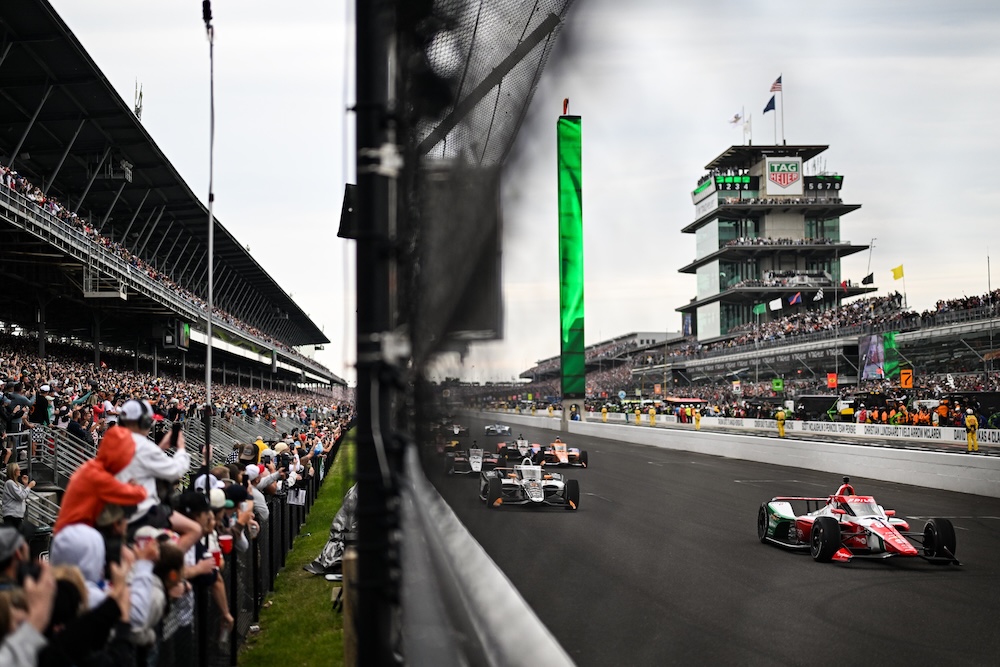
Costs and ROI took center stage when the series was determining the engine formula for 2028 and beyond. James Black/Penske Entertainment
LISTENING AND ACTING
Advertisement
With ROI in mind, the messages received by IndyCar from many (but not all) of the car companies it’s spoken with has been clear: Keep the engine displacement small, avoid a ruleset that triggers a financial arms race, and place a stronger emphasis on the electrification side of the powertrain equation.
In simple terms, the plan for 2028 is to go racing with something compact, sturdy, and familiar that doesn’t break the bank. And if advancements are going to be made, do it with the hybrid because that’s where research and development has value and relevance for a growing portion of the auto industry.
Make no mistake; the internal combustion engine is a vital component in most road and race cars, but in this new era of hybridization and electrification, spending generously on piston-driven IndyCar engines alone – at least at the present level – has met its end.
HISTORY OF THE 2.4
It’s been a long journey to get to a point where the majority of the 2028 engine formula exists.
By the time the new motors see their first checkered flag later this decade, 10 years will have passed in the transition from concept to reality with the 2.4s. Set to replace the 2.2-liter turbo V6s from Chevy, Honda, and Lotus that debuted in 2012, IndyCar made an announcement in 2018 that brand-new 2.4-liter twin-turbo V6s would arrive in 2021.
The 2.2s didn’t pack much of a punch on debut in 2012, and with each new season, they were being pushed harder to generate the power and speeds that were originally envisioned by the series. Each push also came with increased risks to reliability.
Advertisement
With the rules requiring every engine lease to provide four motors per car that last 10,000 combined miles of running, explosions were happening at an alarming rate as the engines approached their 2500-mile change-outs. Once a motor crept towards 2000 miles, a countdown clock began as there were no guarantees it would get to 2500 without something snapping or detonating. It was an expensive problem for the manufacturers to absorb, and became an issue for IndyCar to solve as it started to contemplate what might supersede the 2.2s.
On its own, the increase from 2.2 liters to 2.4 wasn’t going to be a cure-all, but the breakages and their ensuing costs inspired new rules that called for original designs for 2021 with more material thickness in troublesome areas.
The 2.4s would offer a modest leap in power, which was a bonus, but the real motivation behind creating burly new 2.4s was engineering robustness into the formula that would restore the reliability and longevity that was being lost with the overstressed 2.2s.
“The current 2.2, and the amount of capabilities that those manufacturers have gotten out of it when you look at where it started and where it is now in terms of performance, they are truly maxed out, and in a very impressive way,” Mark Sibla, IndyCar’s Sr. VP of competition and operations, told RACER.
“The 2.4 allows us to bring down the stress that the engines are under, which also helps a bit from the cost perspective. Nobody’s really excited to understand rebuild costs, but there’s things like going to a bigger engine and not having to push it as hard as the 2.2 that you can do get more life from the engines.”
Advertisement
In August of 2019, when IndyCar announced it would be adding a hybrid component to the formula, the original target to have new 2.4s racing in 2021 was adjusted to 2022. Beset by a number of delays, the target for the hybrid 2.4 formula was then shifted to 2023. Independent from the hybrid setbacks, the larger 2.4 engines were indeed made by Chevy and Honda, and by March of 2022, the 2.4s went track testing in public for the first time at the Indianapolis Motor Speedway road course.
More testing and development continued throughout 2022 as both brands prepared to go racing with the 2.4s in 2023, but delays with IndyCar’s conversion to hybridization – something managed entirely by the series up to that point – led to another change of plans.
Despite rumors to the contrary, Chevy was fully prepared to go racing with its 2.4s. And Honda, with a new IMSA GTP program also set to go live in 2023, took a novel approach and built its 2.4s to cover two fronts by powering IndyCars and its hybrid Acura ARX-06s.
Together, their 2.4 internal combustion engines were done and ready, but the hybrid solution outsourced by the series had fallen through.
In December of 2022, just four months prior to the IndyCar debut for the 2.4 hybrids at the season-opening race, Chevy and Honda intervened and agreed to help the series by taking over the hybrid project. But it came at a cost. A lot of unappropriated money was needed to make the systems, and the only obvious places to draw from were their 2.4 budgets, which meant parking the 2.4s and sticking with the 2.2s in the interim.
The rivals joined forces to develop, manufacture, and track test the hybrid systems in the latter part of 2023, and under the revised timeline, Chevy and Honda would bring the new 2.4s and their new energy recovery systems to bear in 2024. But that was also subject to change.
Advertisement
Hybridization would eventually arrive in June of 2024 with a midseason debut at Mid-Ohio, but the 2.4s remained silent as the series and its manufacturers opted to stick with the trusty 2012-era 2.2s until IndyCar delivered a new chassis to market.