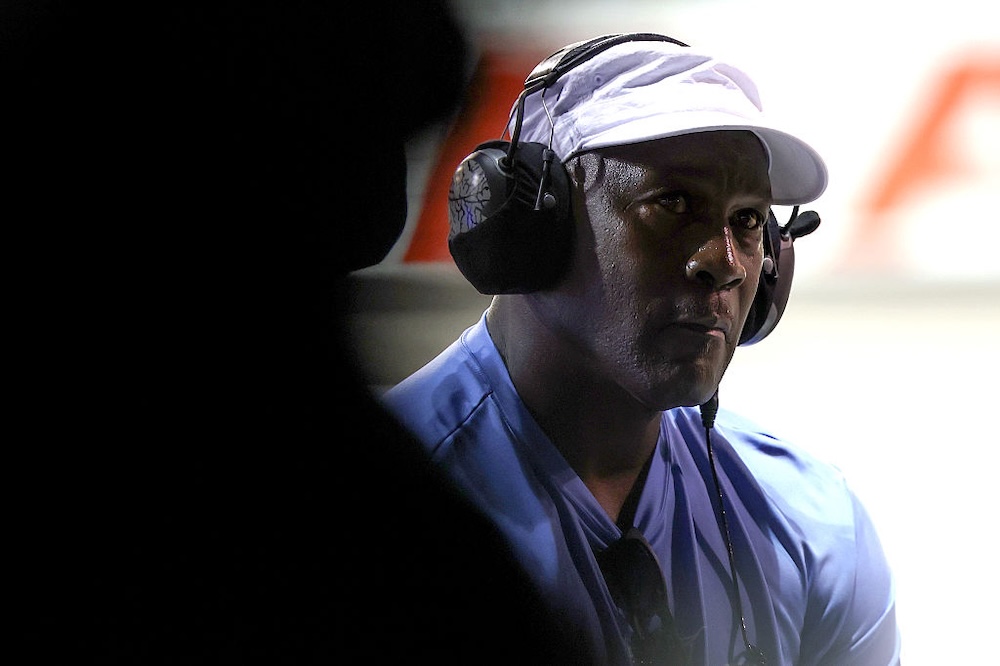
Jordan takes the stand in NASCAR antitrust case

Advertisement

Michael Jordan, a lifelong NASCAR fan and now majority owner of 23XI Racing, explained in federal court Friday that he’s suing the sport he loves because the economics are not being handled fairly.

23XI Racing and Front Row Motorsports were the only two of 15 teams that did not sign the charter agreement that began in 2025. The joint antitrust lawsuit was filed in North Carolina federal court in early October 2024.

“Someone had to step forward,” Jordan said of taking such action. “I wasn’t afraid.”

Jordan was pitched by Denny Hamlin to start the team that has become known as 23XI Racing. Those off-the-cuff conversations were intriguing enough for Jordan to review the pitch deck Hamlin sent and to want to get involved. The team formed in 2020 and debuted in 2021.

However Curtis Polk, Jordan’s financial advisor and partner in 23XI Racing, did tell Jordan that he felt the venture was “risky to your brand and image.” Jordan smiled on the witness stand when counsel for NASCAR assessed that Polk admitted he didn’t enjoy NASCAR as much as Jordan and that he wasn’t as big a fan.

“Obviously not,” Jordan said.

Jordan estimated he’s invested roughly $35-40 million into the race team, which he does not have a day-to-day role in. Considering himself “more of a fan,” Jordan leaves those details to Polk and Hamlin, but is made aware of what is going on.

Jordan was the one who paid the $28 million to buy a third charter and expand to three teams. Hamlin pitched it as another opportunity to win races and improve chances to compete for a Cup Series championship.

U.S. District Judge Kenneth Bell previously ruled that NASCAR is a monopoly. The teams are looking to show that NASCAR used that power in an anticompetitive manner and that its business model is hurting the race teams. Jordan explained that once he and his partners entered the sport, upon signing the previous charter agreement, they really got to understand the business and the economic model.

“I’m not discrediting what NASCAR has done for the sport,” Jordan said. But he wants to push to improve the sport.

Speaking on the witness stand, Jordan said he believes there needs to be growth and unity across NASCAR and its drivers. He also explained how that has worked in stick-and-ball sports with a business partnership between the league and its participants. And in doing that, he’s come to believe that the ups and downs of growth and finances should be a shared responsibility.

Advertisement

“The thing I’m hoping for is you create more of a partnership between two entities,” Jordan said. “If that’s the case, it becomes a more valuable business. If you can ever compromise on the things that matter, you can grow your business.”

There were multiple reasons why 23XI Racing didn’t sign the charter agreement, according to Jordan: it wasn’t economical; counsel offered advice on the clause about not suing NASCAR; and the ultimatum to sign it didn’t “best suit 23XI.” The lack of a partnership, permanent charters, say in governance of the sport, and the requested money were at the heart of those issues.

Jordan testified for 25 minutes before NASCAR was given the chance to do its cross-examination. During that time, NASCAR asked about previous statements Jordan had made about NASCAR and the charter system, in which he clarified that he can speak highly of the sport and the system, but not the agreement.

NASCAR counsel also asked about messages Jordan and Polk exchanged during the charter negotiations. Polk was more actively involved in those negotiations than Jordan, but he admitted he attended meetings to understand the race teams’ and 23XI Racing’s asks.

Advertisement

In one message, Polk told Jordan, “Our plan is to be a pest and have a mosquito bite every week.” The meaning was to continue conversations with teams/drivers and have things end up in the media. Polk also wanted to meet with some of the smaller teams in the garage to explain why the offer they thought NASCAR was making was not good for their teams.

“We wanted them to understand what was fair and what was not fair (about the economics),” testified Jordan.

Other proceedings from Friday:

The NBA legend and North Carolina native was the third witness of Friday’s proceedings. The day started with NASCAR president Steve O’Donnell finishing his testimony, which began Thursday. Heather Gibbs, a co-owner of Joe Gibbs Racing and the daughter-in-law of Joe Gibbs, was the second witness.

Gibbs testified for about an hour, which led into the lunch break. After giving her background on how she got into racing by meeting and marrying Coy Gibbs in the 1990s, Heather Gibbs spoke publicly for the first time about Coy’s passing in 2022. It was the night Ty Gibbs won the Xfinity Series championship on Nov. 5, 2022.

“He didn’t wake up,” Heather said.

Heather Gibbs said she became a co-owner of Joe Gibbs Racing on Nov. 6. She is involved in strategic decision-making and was part of the charter agreement negotiations.

Gibbs described the sport as “very challenging for the teams” because of its financial model, and said Joe Gibbs Racing does not have outside income. NASCAR racing is its business.

Advertisement

A comment by NASCAR commissioner Steve Phelps about reckless spending by the race teams prompted Gibbs to write a letter that was sent to multiple NASCAR executives and the France family. Gibbs said the comment bothered her, and she disagreed with it. The lengthy letter, which became public a few weeks before the trial started, consisted of Gibbs explaining how much NASCAR means to the Gibbs family and the need for a stronger sport, including with permanent charters.

Lesa France Kennedy was the only one who responded to Gibbs’s letter. Gibbs felt it was a nice conversation, France seemed receptive, and Gibbs thought her letter had been impactful. But no other NASCAR executives responded.

“I think (permanent charters) are absolutely vital for the teams,” Gibbs said. One of the main reasons is the stability they provide, as what the organization has built can’t be taken away.

Gibbs would further detail how upsetting the deadline to sign the charter agreement was. NASCAR sent teams a notice on August 30 that the deadline was September 6. Joe Gibbs Racing did sign the agreement, but Gibbs used the “gun to the head” expression that some others involved in the case have used to describe the feeling.

“I did not think it was a fair deal for the teams,” Gibbs said.

But through the emotion, the organization signed it because of its legacy and not wanting that to disappear.

Gibbs also acknowledged during her testimony that some years are profitable for Joe Gibbs Racing and some are not.