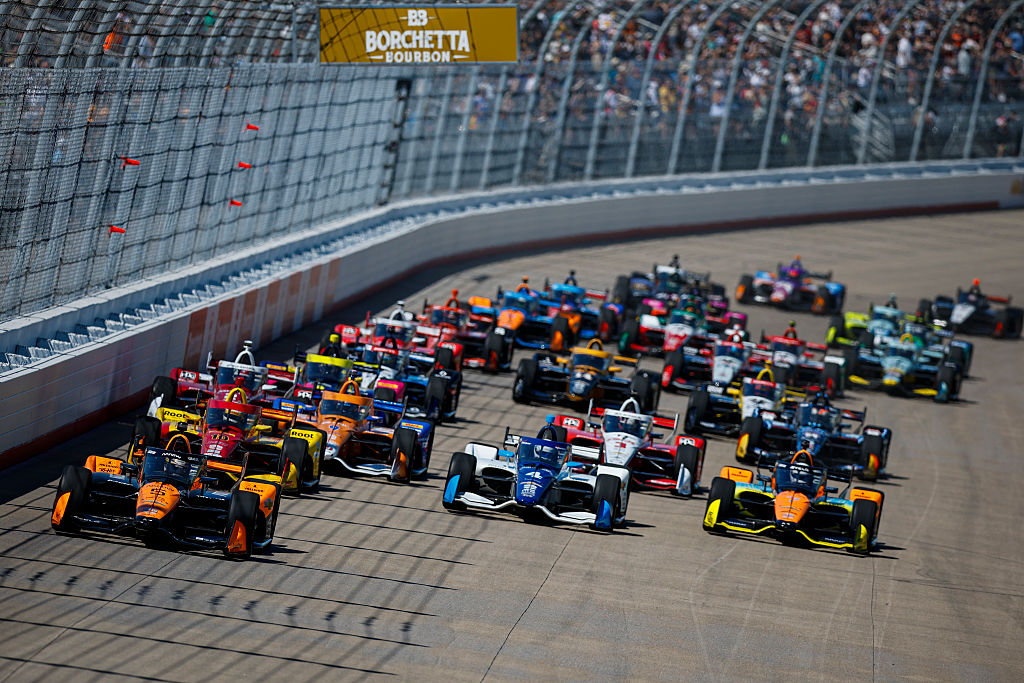
The IndyCar Series has some significant candidates to consider for its biggest moment of the year, and I’m choosing a piece of business from the end of July that flew somewhat below the radar with the 33-percent sale of Penske Entertainment to Fox Corporation.
If you’re a longstanding fan of the series, there’s also a strong chance you’re a long-suffering supporter who misses the glorious 1980s and 1990s when the CART IndyCar Series enjoyed its final reign as the country’s most popular form of motorsports. And if you’re a newer fan, you’ve never known a time when IndyCar was more than a distant second to NASCAR and fighting hard to stay out of third place during Formula 1’s national rise.
Toppling NASCAR and passing F1 won’t be easy, but this unprecedented business move between a North American racing series and its broadcaster – akin to a marriage – has the potential to create fundamental change to IndyCar’s popularity and prosperity for the long term. It’s a play from Liberty Media, which bought the rights to F1 and MotoGP, but applied to a regional series where this serves as a new move.
Time and effort will tell if the onboarding of Fox as the co-owner of IndyCar and Indy NXT and the Indianapolis Motor Speedway delivers the kind of lift that’s possible, but at its core, the union should place the series in a position of favor with a broadcaster that is unlike anything its rivals have secured for themselves in domestic racing.
Prior to FOX, IndyCar’s broadcast story was often one of being buried by its former partners below bigger stick-and-ball sports. It wasn’t entirely undeserved, but the practice did establish a frustrating Catch-22 where IndyCar wasn’t big enough to demand frontline presentation with an all-network calendar of races, but without the all-network positioning, IndyCar stood no chance of becoming a bigger deal to warrant featured network slots for every race.
And then FOX Sports CEO and self-avowed IndyCar fan Eric Shanks saw something in the Roger Penske-owned series that others did not, which led to signing IndyCar to an all-network contract for 2025 and fostering the relationship where Penske invited Fox Corporation to take a meaningful financial stake in the series.
Many others approached Penske to buy into the series or take full ownership, and they were firmly rebuked in each instance; only Fox, with this unique media co-ownership angle, made it across the finish line. It’s in the obligation that comes from purchasing a one-third stake in Penske Entertainment where the series’ fortunes should shift.
NASCAR opens its season on FOX, and that won’t change anytime soon, but the company has chosen IndyCar as its full-time partner and given itself a vested interest in making the series as big as possible for the sake of its shareholders.
From creating brand-new IndyCar races with Penske to moving the start dates and times around the calendar to maximize the series’ chances of attracting one million or more viewers per race, the sale to Fox brings new momentum and genuine expectations for IndyCar to become more – much more – than it is today.
Advertisement
Reaching the same high peak from the CART era’s best days would be a lot to ask, but for the first time in far too long, it doesn’t feel silly to imagine a brighter and fuller future for the series. This was little more than a post-CART dream, and one that went unrealized for decades until Fox, FOX Sports, and Shanks turned the concept from fantasy to reality. Simply put, IndyCar has been fully embraced by immensely powerful media entity that wants to take it to the top, and now it’s time for action.
There’s another business-related item brewing between Penske Entertainment and key members of the IndyCar community. It’s different from the Fox sale, but falls into the same category of bringing change-makers deeper inside the open-wheel family.
Multiple sources have told me about a pre-Christmas team owners’ meeting where Penske Entertainment outlined plans to offer charter memberships to Chevrolet and Honda. Unlike Fox, Penske isn’t making a percentage of the company available for purchase, but it’s an inventive approach to creating equity for manufacturers who invest in the series with no backend payout to recoup some of their financial outlay.
Chevy and Honda have been critical partners for years, but involving them in the prospective charter program could be a game-changer. Jake Galstad/Lumen via Getty Images
Penske established its first charters entering the 2025 season where 10 veteran teams and their 25 combined entries were given charters that guarantee participation in every race – except for the Indy 500 – and can be sold for their personal gain, just as NASCAR teams have done with their charters.
In the recent meeting, IndyCar’s team owners are said to have been overwhelmingly supportive of the concept as Penske and Fox look to create a stronger embrace of their own for IndyCar’s two engine suppliers. Both are deep in final negotiations to sign contract extensions and stay beyond 2026.
From a tactical standpoint, it’s a brilliant move, and to my knowledge, it would be another unprecedented development in North American racing as Fox, Penske and IndyCar are attempting to create a two-way business relationship with their auto manufacturers.
Advertisement
The standard practice has been for manufacturers to sign on as official partners in whichever series, spend fortunes to participate, and leave the one-sided relationship with nothing tangible to hold in exchange for their expenditures.
With the offering of charters to Chevy and Honda, and possibly one or two more manufacturers if they sign quickly in order to be ready for the new 2028 engine formula, Fox and Penske are trying to change the one-sided dynamic.
Being given a valuable commodity with a charter creates a newfound connection to the series that comes with a bigger voice which goes beyond the typical supply contract. The charters would bring IndyCar’s manufacturers into the same meetings with team owners and help to shape the series’ direction, and while those conversations have always taken place, they’ve happened directly, and often through forceful means with the applying of leverage through their supply agreements.
Being welcomed as charter members, with genuine seats at the same table as IndyCar’s charter teams, would represent a radical alteration to how a major racing series conducts its bus iness.
Manufacturers would receive a single charter and have the ability to sell their charter upon exiting IndyCar, but with a restriction that prevents the sale to a team; Penske Entertainment would buy the deed from the car company at market rate.
Another interesting item was presented by Penske where manufacturers would be allowed to use their charters to become entrants and field single-car factory programs.
Advertisement
Factory links, especially back in the best days of CART, were customary as Buick, Chevy, Ford, Honda, Mercedes and Toyota chose specific teams to put their brand support behind and fund. It’s unclear whether Penske’s vision for manufacturer charters would require forming a true standalone team that’s independently run by a Chevy or Honda, or if outsourcing the fielding their entries to one of the existing teams –just as both brands do when they need engine or hybrid testing done – would be permitted.
Either way, and provided Chevy, Honda, ink new deals to stay after 2026, supply the current engines during the gap year in 2027, and build the new 2.4-liter twin-turbo V6 motors for 2028 along with any other manufacturers, the new twist of receiving charters would possibly add to IndyCar’s grid.
It’s a lot to ponder, especially when Penske is contemplating a reduction in its full-time grid of 27 cars in the coming years, but like the sale to Fox, forging deeper relationships with auto manufacturers would potentially address another shortcoming.
When they’ve been motivated, and that hasn’t been the case in recent years, car companies have applied vast marketing budgets to promote their involvement in IndyCar; the effects were seen with larger audiences and heightened national awareness for the series.
Offering charters wouldn’t be a magical key that gets a Chevy or Honda or others to unlock eight-figure annual advertising spends, but it’s a fascinating first step towards rebuilding IndyCar’s stature with companies who’ve been viewed as outsiders, and haven’t been given incentives to play a bigger part in the series’ restoration.
During Penske Entertainment’s sixth season of ownership, the business side of IndyCar is where foundational developments took center stage. With the arrival of 2026 and a new season set to launch on March 1, concepts and potential and possibilities with Fox must be turned into indisputable results. Keeping Chevy and Honda, at a minimum, is a must, and they’ve been handed new reasons to stay.
Advertisement
Happy New Year, everyone, and I can’t wait to look back a year from now and reflect on how the big business moves affected IndyCar.
We use cookies to ensure that we give you the best experience on our website. If you continue to use this site we will assume that you are happy with it.