Welcome to the RACER Mailbag. Questions for any of RACER’s writers can be sent to mailbag@racer.com. We love hearing your comments and opinions, but letters that include a question are more likely to be published. Questions received after 3pm ET each Monday will be saved for the following week.
Q: Do you have any new information on the IndyCar Series video game that iRacing is creating for gaming consoles as well as PC? It supposedly coming out in 2026, but I haven’t read or heard anything more about it since the announcement.
As you know it’s been 20 years since the last IndyCar video game was released, which is way too long. I’m hoping that the developers of the new game might have images or a trailer for it soon and that a lot of progress has been made.
It was nothing short of depressing when the game that Motorsport Games was contracted to create and finish fell apart.
David Colquitt
MARSHALL PRUETT: Not sure I saw it as depressing. More of a living down to expectations, since everybody who knew it was a terrible choice told Penske Entertainment it would fail, and then it did. I reached out to the series and they tell me the release timeline is still good and to look for something in the second half of 2026.
Q: My first question concerns Oliver Askew. I just saw that he has re-signed for a reserve role with Andretti in Formula E. Is there any chance we’ll see him back behind the wheel in a race one day, whether in Formula E, IMSA, or elsewhere? Oliver was a real talent who never had the opportunity to demonstrate it at a high level, and after three years without racing, a comeback seems very unlikely.
My second question concerns Dale Coyne. I’ve read some articles saying that Honda might be considering placing Tsunoda in IndyCar in 2026 if he were dropped by Red Bull. Do you have any information on this? Along the same lines, Red Bull driver Ayumu Iwasa has just been crowned Super Formula champion; could we see him in IndyCar with Dale Coyne, also through Honda?
Yannick
MP: On Coyne and Tsunoda, you might have noticed we never mentioned it in any of our silly season pieces, and that’s because it was a nothingburger. If Coyne wants to hire Iwasa, he will, but as Honda is entering the last year of its IndyCar engine supply contract, it isn’t going out and offering teams $8-10 million to run someone.
Agreed on Askew. Tons of talent, but it looks like he’s been lost to the passage of time and relevance within IndyCar as a young talent to pursue. He’s the 2019 Indy Lights champion, who had one IndyCar season in 2020 with Arrow McLaren that went sideways, which would mean he should still be in the mix as an option, but he’s years behind Linus Lundqvist, the 2022 Indy Lights champion, who did 1.5 seasons across Meyer Shank and Chip Ganassi, where things did go well.
If you’re shopping for young title-winning talent, there’s a younger and newer model with more shine standing in front of Askew, which is the main problem. But the problem has nothing to do with Oliver’s capabilities.
Q: My question is about the Genesis LMDh program. We know the 2026 WEC driver team (and it’s quite a stout one), but has there been anything rumored about the IMSA one? I imagine there might be a couple of carryover drivers (like Cadillac) since the schedules seem well balanced enough that a combined season is mostly possible (Long Beach/Imola notwithstanding). Have you heard anything about drivers who might be brought in for the IMSA campaign in 2027?
Duncan, Ottawa
MP: I haven’t started to think about the 2027 IMSA part, but I’m expecting some of the WEC roster to get pulled across, and not just on double duty. Derani stands out as a name that fans know, and similar with Jaminet. If I’m trying to make a first-time splash at the highest level of sports car racing in the U.S., I’m going to lean on champions who made their names in IMSA. I’d also look to the reserve roles for 2026 as being primed for race seats in 2027 as well.
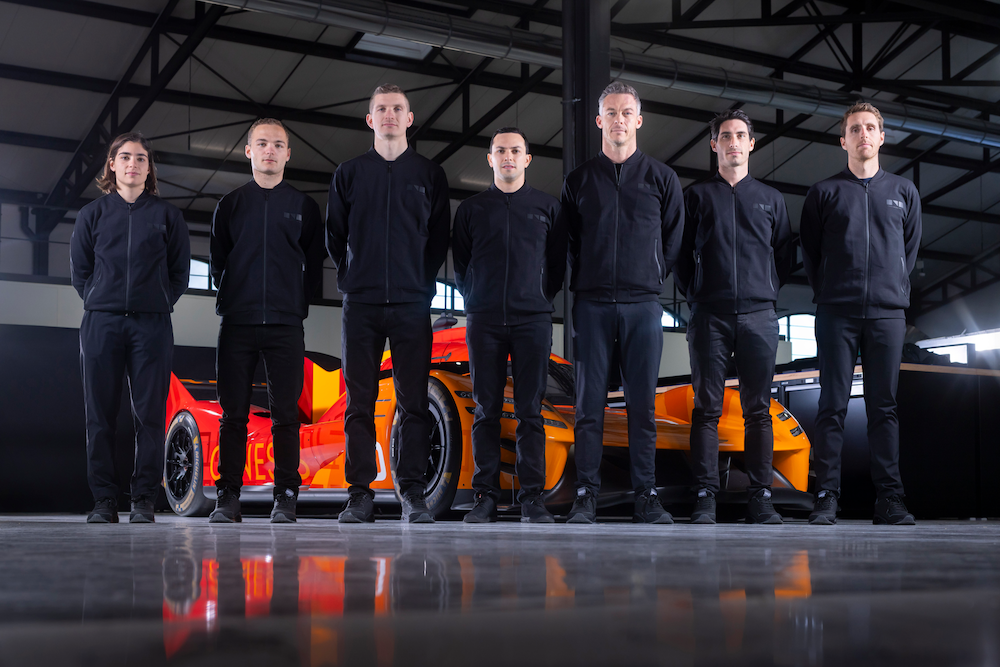
Which drivers from the 2026 Genesis FIA WEC line-up are in the frame to carry their invisible touch over to IMSA in 2027? Image via Genesis Magma Racing
Q: I’ve come to realize the things most race fans want (I assume?) in the IndyCar broadcast just aren’t going to happen. The question is whether that’s because of cost or philosophy. Both? A few items like more cameras are cost-dependent, but where those cameras are placed is a philosophy.
- Track sector times comparing multiple drivers
- Yellow, green, purple track-sector coding
- Audible driver and team microphones
- Pit stop clocks
- Race strategy that includes predictive insight
- Cameras on more cars
- More ghost car
- Slow-motion replay captured with high frame-rate cameras
- Camera placement philosophy. A number of years ago F1 shifted by placing cameras lower, keeping some stationary as cars pass, and moving others left to right to mimic how our eyes follow cars. The result is a stronger feeling of speed and a deeper admiration for what these drivers are doing. Even in social content from teams and drivers, the feeling of speed jumps off the screen.
I get it, nice things cost money. It’s unrealistic to expect an F1 broadcast. These races can only support a certain level of financial commitment, but does that mean improvement isn’t possible?
Matt
MP: I enjoy many of the items you’ve listed as features offered in F1 broadcasts. I also appreciate the vast production budget F1 has at its disposal, which is what you’d expect from the world’s second most popular sport. As you noted, the same level of budget wouldn’t be carved out for the second or third most popular regional racing series, which is where IndyCar falls domestically behind NASCAR and possibly F1.
But improvements are always an option. IndyCar’s TV content has, for more than a decade across a range of broadcasters, been lacking with the in-race analysis part of the broadcasts. Thank goodness for Hinch, who does his best to be a lead commentator, driver analyst, and to drill into the strategy side when possible. All of the items you’ve suggested on amplifying that part – giving smarter fans more data to do the math or work the strategy on their own, which is something F1 has absolutely fostered – are long overdue.
We once lived in a time when viewing was a passive thing, but expectations have risen, especially with newer and younger fans who’ve grown up on modern F1, where there’s a steady barrage of info given to educate or arm viewers with what’s needed to do more than just watch zoomy cars go around for our entertainment.
Q: Have you heard what IndyCar horsepower levels will look like with the new 2.4-liter engines? And is the target weight loss of the car expected to be around 80-100 lbs?
Joe
MP: We’re talking about goals at this stage, and it’s 800 hp to start. The current 2.2s are good for 750 hp or so, and that’s at a crazy-high level of stress. I’d put a starting range of 750-800 hp, which isn’t as big of a stress, as the likely debut for the 2.4s. Yes, the goal is to take 80-100 lbs off the car and if they’re successful, most of the reduction will come from the back half of the car through lighter hybrid and transmission componentry.
Q: Have you heard if the WWTR race will take place on Sunday night again? I think that was my favorite race of the year.
Have FOX and IndyCar discussed the possibility of weeknight prime time races? That could be a way to possibly extend the season into football season without going head to head with the NFL on Sundays.
Bob
MP: The schedule release from IndyCar said WWTR and Nashville will be under the lights, so yes, nighttime racing is what’s planned. I’m hearing tune-in times from FOX for all the races are imminent. I’m sure the concept of weeknight races has been broached, but I’ve heard nothing to suggest anything is happening in the near term.
Q: Robin Miller and I were longtime friends. We shared a mutual passion for IndyCar racing from childhood through our adult years. We each were blessed and fortunate to have careers in the sport we loved. I looked forward to and enjoyed my stimulating discussions with Robin.
One of our many discussion items was Robin’s “IndyCar Mount Rushmore.” Robin’s nominees were AJ, Mario, Parnelli and Dan Gurney. Robin was always anxious to explain his rationale for his nominees. He would also provide his reasons for why other drivers did not make his top four. His background and his knowledge base provided comprehensive insights to support his reasoning.
Did you and he have discussions about his Mount Rushmore that you can share, and did you agree with his nominees?
Steve, Chapel Hill, NC
MP: I was one of maybe 10 people in attendance for the filming of Robin’s Mount Rushmore video at IMS Productions back in 2011, which was phenomenal. The only disappointment is that Foyt refused to show up because Mario was there – this was before they became BFFs. Listening to Robin curse him out over the phone just before filming began while trying to goad him into taking part in the conversation was pure gold.
I’ve always loved the spirit behind Robin’s Mount Rushmore, and it’s loaded with a ton of sentimentality. We spoke about it or the main characters often, and all of the reasoning behind the four, from their on-track excellence to their technical innovations, to their uplifting of the sport’s profile, to their longevity, make all four the perfect choices for his Mount Rushmore. But it’s not the Mount Rushmore of IndyCar. We all have our own.
Very much a case of the four being specific to the time Robin came into the sport; he was 12 when A.J. won his first 500, 14 when Rufus won, and 20 when Mario won. Our mutual hero, Dan Gurney, didn’t win, but was one of the greatest to finish second. They all were the biggest stars of the 1960s, part of the 1970s for some, and A.J. and Mario continued to share that crown into the 1980s and ’90s. Take whatever level of popularity Pato O’Ward has today, multiply it by 100, and that’s who Robin’s Mount Rushmore were to IndyCar and the Indy 500 back then.